Finance leaders today face a structural shift in how decisions are made, risks are monitored, and performance is governed. AI adoption finance is no longer an experimental initiative led by IT departments. It is a strategic and operational priority that demands a clearly defined CFO AI strategy anchored in governance, data discipline, and measurable outcomes. The real challenge is how finance leaders implement AI without weakening compliance, control, or accountability.
Where Traditional Finance Models Start to Strain
Most finance teams still rely on layered manual reviews, spreadsheet consolidation, and reactive reporting cycles. While these processes feel structured, they often conceal inefficiencies that surface during audits, forecasting cycles, or executive reporting.
Manual reconciliations increase the risk of errors, and fragmented systems delay month-end close and forecasting updates. A 2024 Gartner survey found that 58 percent of finance functions reported using AI technologies in their operations, reflecting a measurable rise in adoption across transactional processes, analytics, and error detection (source). Despite this growth in enterprise AI finance, many organizations remain confined to limited pilot programs that struggle to scale.
A lack of strong leadership buy-in frequently slows progress. Without executive alignment and a structured finance AI roadmap, AI initiatives remain isolated experiments rather than embedded operational capabilities. At the same time, concerns from risk management teams about data integrity and auditability often stall broader deployment. In many cases, entrenched finance culture reinforces caution, prioritizing stability over innovation.
The consequence is significant. Finance professionals spend more time validating historical data than generating forward-looking insights.
Why Does AI Adoption in Finance Struggle Inside Large Enterprises
AI adoption finance struggles when organizations treat AI as a technology upgrade rather than an operating model transformation.
A successful enterprise AI finance initiative depends on structured data, standardized workflows, and clear governance accountability. When systems lack integration or when data quality is inconsistent, AI outputs become unreliable. Research on AI implementation challenges in finance highlights that poor data quality and integration gaps are leading barriers to sustainable adoption (source).
Another barrier is weak AI change management. Finance teams require transparency, audit trails, and defined exception handling before trusting automated systems. Without a deliberate approach to change communication and governance clarity, resistance becomes embedded across departments.
A disciplined CFO AI strategy, therefore, begins with operational redesign, stakeholder alignment, and a realistic assessment of AI readiness.
What High-Performing Finance Teams Do Differently
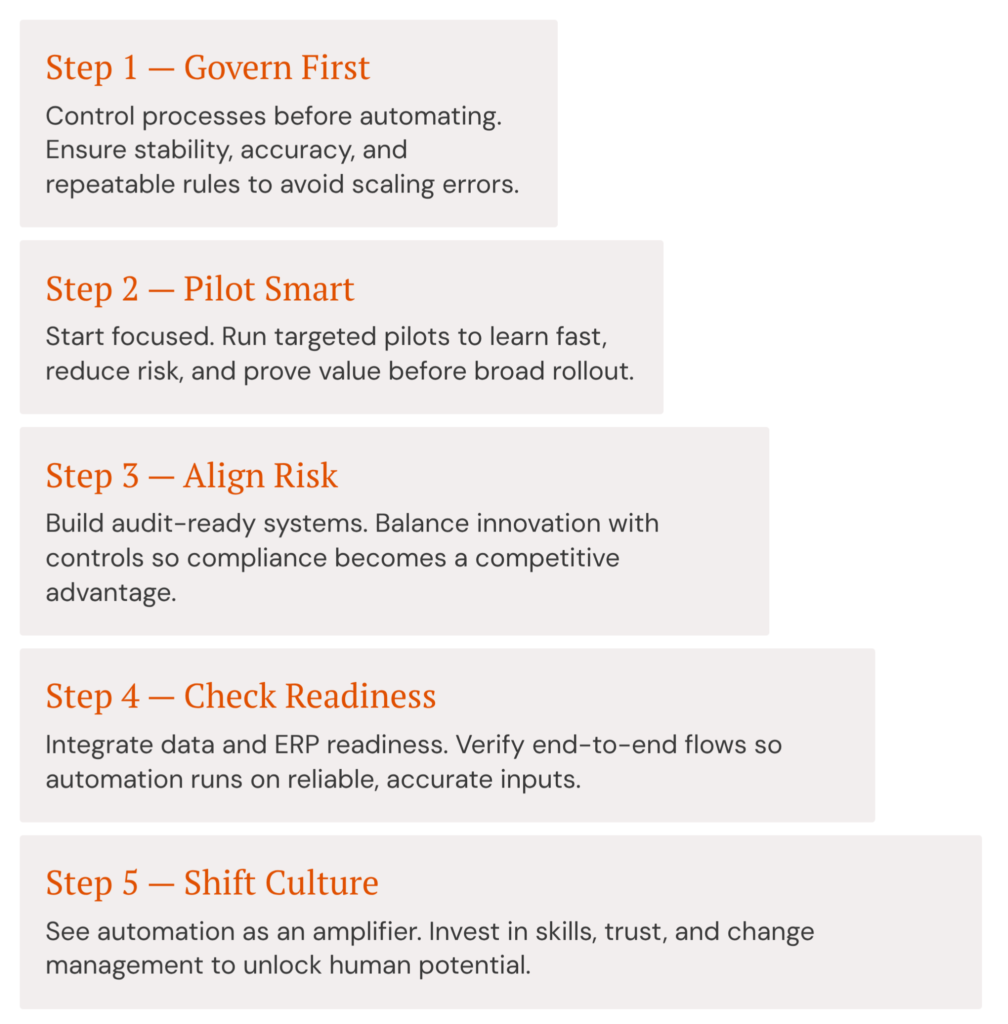
High-performing teams approach AI adoption finance with structure and measurable intent.
The following practices consistently distinguish organizations that scale AI successfully from those that remain stuck in experimentation:
- Define Governance Before Automation- They document workflows and control checkpoints before deploying AI. This ensures automation strengthens compliance rather than bypassing oversight mechanisms.
- Run Structured Pilot Programs- Focused pilot programs target high-volume, rules-based activities such as invoice validation or automated vendor reconciliation. Early measurable wins build durable leadership buy-in.
- Embed Risk Management Early- Strong collaboration with risk management and compliance teams ensures transparency, audit trails, and policy alignment remain intact during implementation.
- Assess AI Readiness Objectively- Teams evaluate data integrity, ERP integration capability, and workflow standardization to determine true AI readiness before scaling enterprise deployment.
- Align Culture With Strategy- A forward-looking finance culture embraces automation as a control enhancement tool rather than a threat to professional roles.
Building a Practical Finance AI Roadmap
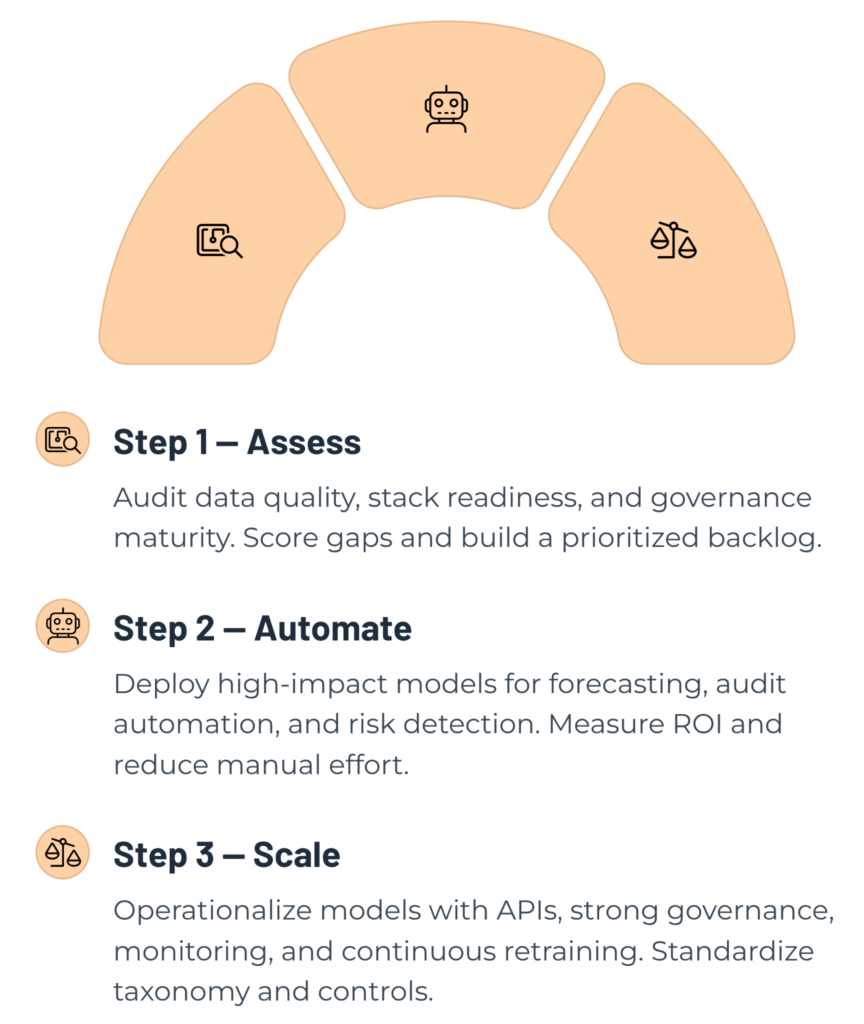
A structured finance AI roadmap prevents fragmented experimentation and enables scalable growth.
The first phase centers on readiness assessment. CFOs evaluate system integration gaps, data reliability, and workflow consistency to establish a realistic baseline for enterprise AI finance deployment.
The second phase prioritizes use cases with measurable operational impact. Accounts payable automation, anomaly detection, and forecasting optimization provide controlled pathways to demonstrate value while preserving compliance and oversight.
The third phase focuses on integration and governance. Seamless ERP connectivity ensures AI operates as an embedded component of financial infrastructure rather than as a disconnected overlay. Real-time analytics and audit visibility reinforce transparency and strengthen control frameworks.
Throughout each phase, strong AI change management ensures communication, training, and accountability remain consistent.
Solutions such as an AI-powered finance automation platform like Fintropi support this structured roadmap by enabling automated vendor reconciliation, unified data integration, and insight-driven financial oversight within established governance boundaries.
What Shifts When AI Adoption in Finance Is Executed Well
When AI adoption in finance is executed with discipline, the transformation is measurable.
Accuracy improves as transaction-level controls operate continuously. Reliability strengthens as automation reduces manual reconciliation errors. Decision-making accelerates because finance leaders gain near real-time visibility into performance metrics.
A well-executed CFO AI strategy improves forecast confidence and capital allocation decisions. Structured enterprise AI finance initiatives also enhance cross-functional collaboration, since unified data enables consistent reporting across departments.
Over time, a resilient finance culture evolves, recognizing AI as a performance amplifier rather than a disruption.
Measuring Success Beyond Cost Reduction
While efficiency gains are important, a mature finance AI roadmap measures success through broader performance indicators.
Key metrics include reduced cycle times, improved forecast variance accuracy, fewer audit adjustments, and stronger transparency across reporting layers. Organizations that embed AI into financial operations consistently report measurable improvements in decision quality and operational efficiency.
Sustainable performance requires ongoing AI change management, reinforced governance, and periodic reassessment of AI readiness as systems evolve.
Competitive Advantage Through Enterprise AI Finance
Organizations that operationalize enterprise AI finance gain structural advantages.
Faster reporting cycles support quicker strategic decisions. Improved risk management reduces compliance exposure. Enhanced forecasting strengthens investor confidence and capital allocation precision.
A structured CFO AI strategy ensures automation scales without eroding oversight. When supported by consistent leadership buy-in, AI becomes a durable capability rather than a temporary initiative.
Bottom Line
AI adoption finance demands deliberate execution, strong governance, and measurable accountability. When finance leaders anchor transformation in realistic AI readiness, structured pilot programs, disciplined AI change management, and sustained leadership buy-in, automation strengthens both control and performance.
The way forward involves building a practical finance AI roadmap that integrates governance, scalability, and transparency across every workflow. Download the Guide to explore how an AI-native Autonomous Finance Operations Platform like Fintropi can support structured AI adoption in finance with seamless ERP integration, automated vendor reconciliation, and insight-driven financial oversight.
Finance leaders who approach transformation with strategic clarity will position the finance function as a long-term driver of resilience and competitive strength.
FAQs
- What is AI adoption finance in practical terms?
AI adoption finance refers to integrating artificial intelligence into financial workflows such as invoicing, reconciliation, forecasting, and reporting to improve operational accuracy while preserving compliance standards.
- How should a CFO build a CFO AI strategy?
A strong CFO AI strategy begins with assessing AI readiness, launching focused pilot programs, aligning with risk management, and defining measurable performance outcomes within a structured finance AI roadmap.
- What are the biggest risks in enterprise AI finance?
The primary risks include poor data integrity, unclear governance accountability, and weak AI change management processes. Early executive alignment and strong leadership buy-in mitigate these risks.
- How long does it take to implement a finance AI roadmap?
Implementation timelines vary based on organizational complexity and AI readiness. Focused deployments in transactional areas can demonstrate measurable results within months when supported by strong governance.
- How can finance leaders measure ROI on AI initiatives?
ROI can be measured through error reduction, shorter close cycles, improved forecast accuracy, and enhanced transparency enabled by structured enterprise AI finance frameworks.