Growth exposes structural weakness faster than any audit ever will. As transaction volumes expand and reporting expectations tighten, finance leaders face a difficult balancing act. They must strengthen controls, accelerate reporting, and improve insight without continuously increasing payroll. Achieving financial scalability is no longer about hiring more accountants. It is about redesigning operations, so expansion does not automatically translate into higher fixed costs.
When Growth Challenges Outpace Process Design
Most organizations begin with finance processes built for modest complexity. As revenue grows, vendor ecosystems expand, and transaction volumes multiply. Over time, manual approvals, spreadsheet reconciliations, and email-based coordination create friction that quietly compounds.
Manual task execution remains one of the biggest constraints on financial productivity. Robotic process automation is defined as technology that automates repetitive, rule-based tasks traditionally handled by humans. When these repetitive tasks remain manual, volume growth directly increases workload.
These growth challenges often surface in subtle ways. Close cycles stretch. Exception handling increases. Reporting accuracy requires more review layers. Lean finance teams end up absorbing operational strain through longer hours rather than better systems. Hiring appears to be the logical fix, yet each additional role increases structural cost and coordination complexity.
Without structural change, operational expansion becomes headcount dependent. That model does not scale efficiently.
Why Does Finance Scalability Break During Expansion?
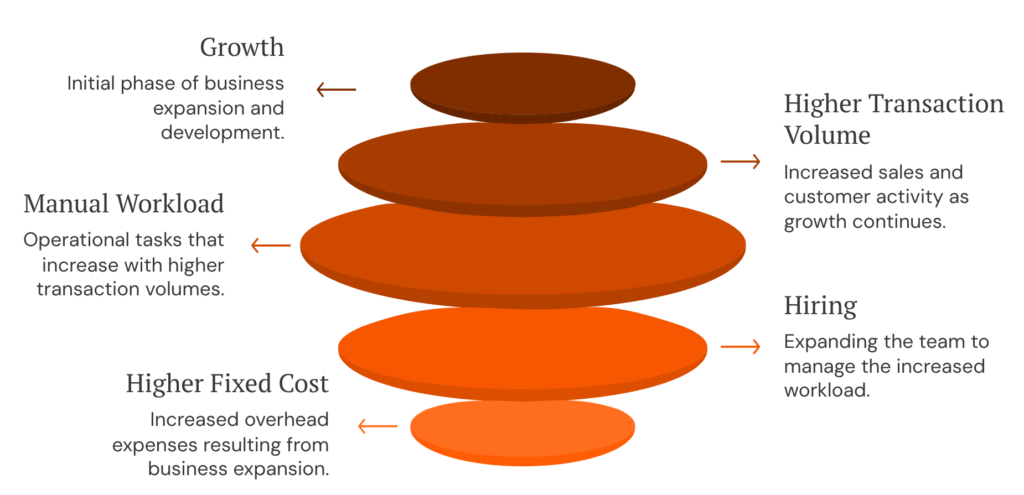
Finance scalability breaks when process architecture fails to evolve alongside business growth. Traditional finance models rely heavily on human oversight for invoice validation, reconciliation, and approval routing. These controls are essential, yet when executed manually, they limit operational scalability.
Automation frameworks emphasize that structured automation reduces error, improves speed, and enhances consistency across financial processes (source). When validation logic is embedded into workflows rather than applied after the fact, performance improves without proportional staffing increases.
The breakdown is rarely about competence. Finance professionals are skilled in managing complexity. The constraint lies in workflow design. Scaling startups often attempt to solve structural inefficiencies with incremental hiring, which temporarily stabilizes output but does not improve architecture.
Sustainable scale requires redesign, not expansion of manual capacity.
Building AI Finance Efficiency Through Autonomous Workflows
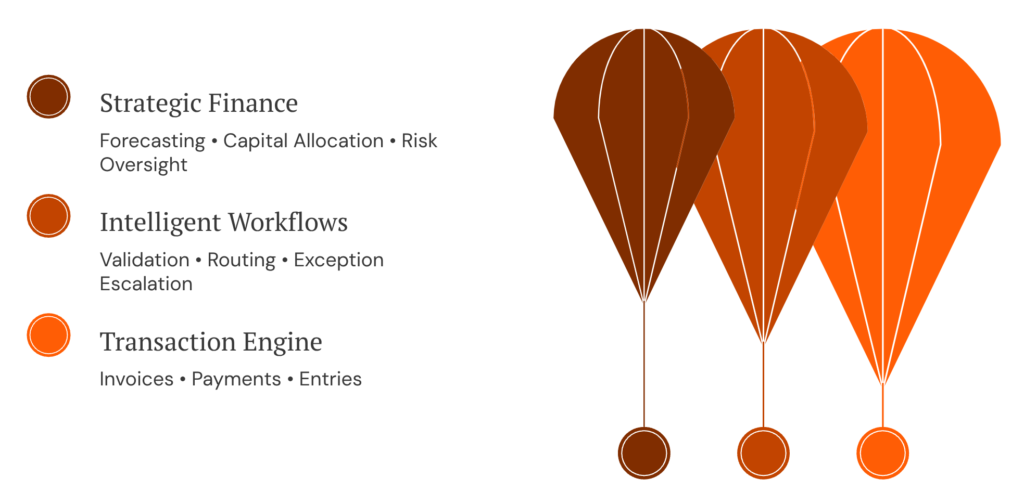
Real AI finance efficiency emerges when repetitive processes are executed through intelligent systems rather than manual intervention. Autonomous workflows validate transactions, route approvals, and escalate genuine exceptions without requiring constant oversight.
This shift changes the economics of finance operations. Instead of reviewing every transaction individually, teams supervise system outputs and focus on anomaly resolution. As a result, lean finance teams can manage higher volumes without proportional increases in effort.
The impact on CFO efficiency is significant. When transaction processing is system-driven, finance leaders can devote attention to forecasting, capital allocation, and risk analysis. Reporting becomes more timely and reliable, strengthening executive decision-making.
Structured automation also clarifies automation ROI. Reduced manual effort, lower error rates, and shorter close cycles create measurable performance gains. These benefits accumulate as transaction volumes grow, reinforcing the value of embedded intelligence.
What High-Performing Teams Do Differently
Organizations that achieve sustainable operational scalability treat finance as an engineered system rather than a reactive function.
- Standardize Before Automating– High-performing teams document core workflows thoroughly. Clear structure enables autonomous workflows to operate consistently and deliver predictable outputs.
- Embed Controls at the Source– Validation rules are applied during transaction entry instead of during end-of-month reviews. This improves reliability and strengthens overall financial productivity.
- Unify Data Architecture– Integrated systems reduce reconciliation friction and improve reporting transparency. Unified data flows directly support finance scalability.
- Measure Automation ROI Transparently– Time savings, accuracy improvements, and faster reporting cycles are tracked systematically. Clear performance metrics reinforce continued investment in AI finance efficiency.
- Elevate Roles Toward Insight– Rather than expanding processing teams, leaders prioritize analytical capability. This shift strengthens CFO efficiency and strategic contribution.
The Transformation: What Changes When Scale Is Designed
When systems absorb structured tasks, expansion no longer creates operational stress. Transaction growth becomes manageable within existing capacity. Accuracy improves because validation logic is applied consistently. Reliability strengthens as workflows execute uniformly across departments.
For scaling startups navigating increasing complexity, this structural stability allows resources to be directed toward innovation rather than administrative overhead. Finance scalability becomes a competitive capability rather than a bottleneck.
Cost efficiency also becomes structural. Instead of hiring reactively during each growth phase, organizations rely on system architecture to manage volume expansion. That stability protects margins and enhances long-term resilience.
Wrapping Up
Scaling finance operations without scaling headcount requires more than incremental automation. It demands embedded intelligence, disciplined process design, and a commitment to operational scalability. When AI finance efficiency powers autonomous workflows, finance transitions from transaction processor to strategic enabler.
Organizations seeking a structured approach to sustainable scale should prioritize systems that embed intelligence directly into financial operations. Scale with Intelligent financial workflow automation like Fintropi to strengthen finance scalability, enhance oversight, and support growth without proportional expansion of headcount.
FAQs
- What does finance scalability mean in practical terms?
Finance scalability refers to the ability of a finance function to manage increasing transaction volumes and complexity without proportional increases in staffing or operational cost. - How does AI finance efficiency improve financial productivity?
AI finance efficiency automates repetitive tasks and embeds validation logic into workflows, increasing finance productivity while reducing error rates. - Why do lean finance teams struggle during rapid expansion?
Lean finance teams often rely on manual processes that cannot absorb rising volume, leading to operational strain and reduced CFO efficiency. - What is automation ROI in finance?
Automation ROI measures the tangible gains achieved through intelligent systems, including lower processing costs, improved accuracy, and faster reporting speed. - How can platforms like Fintropi support operational scalability?
Fintropi supports operational scalability by enabling intelligent, structured workflows that help organizations scale finance operations without scaling headcount.