Audit readiness is no longer a seasonal exercise tied to internal audits or regulatory deadlines. For finance leaders, compliance has become a continuous operational responsibility that affects confidence, decision quality, and organizational trust. As transaction volumes grow and controls become more distributed, traditional compliance models struggle to keep pace. This has shifted the conversation toward systems that are audit-ready by design, where compliance is embedded into daily operations rather than enforced after the fact. In this context, AI is increasingly viewed as an enabler of sustained compliance rather than a reactive control mechanism.
Where Compliance Teams Feel the Strain
Finance and compliance teams often operate under pressure created by fragmented systems, manual reconciliations, and delayed visibility into control effectiveness. Internal audits surface issues weeks or months after transactions occur, while policy violations are discovered only when reporting cycles close. For teams responsible for finance controls, this lag creates uncertainty and repeated remediation work. Over time, manual evidence collection weakens transparency and increases dependency on individual judgment rather than consistent enforcement.
Why Traditional Compliance Models Fall Short
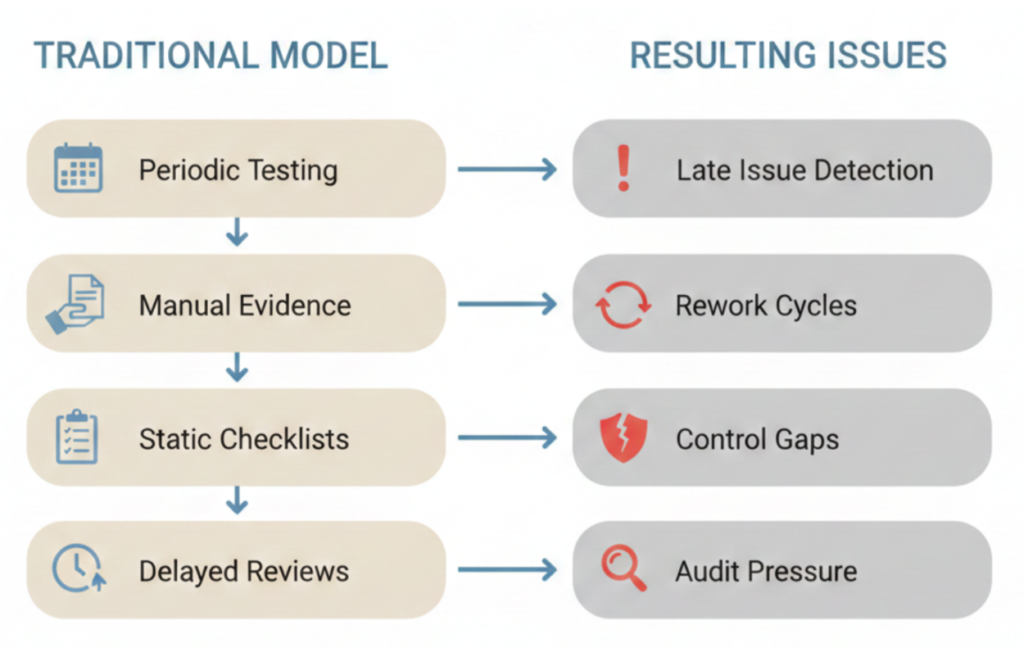
Conventional compliance approaches rely on static checklists, periodic testing, and documentation assembled after activity has taken place. These methods assume stability in processes and predictable risk patterns. In practice, business operations evolve faster than compliance frameworks can be updated.
Policy changes, new vendors, and system integrations introduce gaps that manual reviews rarely catch in time. Open industry education on compliance automation explains how controls that are not embedded into workflows often fail to scale as complexity increases. (Source)
Why Does Manual Compliance Struggle to Scale?
Manual compliance struggles because it treats audit readiness as an outcome rather than a continuous process. Evidence is gathered retrospectively, controls are tested periodically, and accountability is often unclear across teams. Compliance automation supported by AI shifts this model by evaluating transactions and decisions as they occur. Instead of relying on end-of-cycle reviews, audit trails AI captures control activity in real time, improving reliability and reducing dependence on manual logs. Educational explainers on compliance automation describe how automation strengthens consistency while lowering operational effort. (Source)
Core Elements of Audit-Ready Design
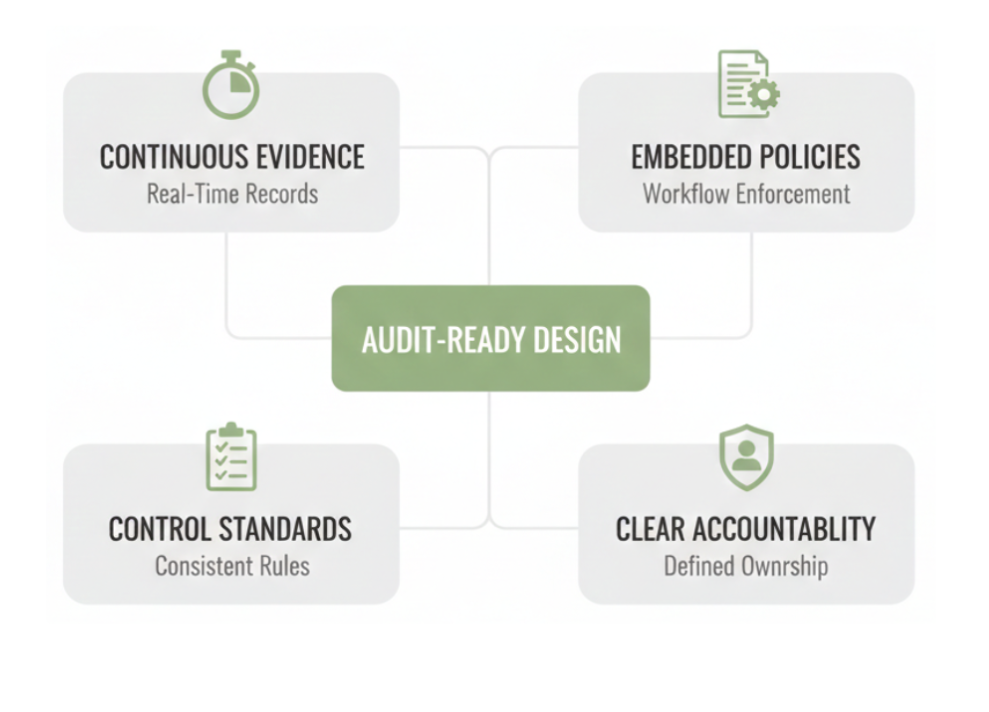
Audit-ready design is built on the following foundational elements that ensure compliance is sustained rather than assembled later:
- Continuous Evidence Generation– Control activity is recorded automatically as processes run, ensuring audit evidence exists before it is requested. This reduces disruption during internal audits and improves confidence in reported outcomes.
- Embedded Policy Enforcement– Policies are enforced within transaction workflows rather than through external reviews. This approach strengthens policy enforcement while preserving operational flow.
- Standardized Control Logic– Rules and risk criteria are applied consistently across teams and systems, supporting stronger governance frameworks and reducing subjective interpretation.
- Clear Accountability Structures– Ownership of controls is defined and visible, which improves oversight and simplifies issue resolution.
How AI Changes the Compliance Equation
AI introduces the ability to monitor control effectiveness continuously rather than intermittently. Regulatory reporting AI supports accurate data aggregation while reducing manual reconciliation. Finance compliance software enhanced with AI evaluates patterns across transactions, approvals, and exceptions, helping teams identify emerging risks earlier. This capability strengthens internal audits by shifting their focus from evidence collection to risk evaluation and process improvement.
Constraints and Misconceptions to Address
AI does not remove the need for governance or professional judgment. Poor data quality, unclear policies, and disconnected systems can limit effectiveness. Teams must also adapt to probabilistic risk indicators rather than binary approvals. Open compliance automation education emphasizes that success depends on aligning automation with defined processes and accountability. AI strengthens decision-making, but it does not replace it.
What Shifts Once Compliance Is Designed In
When compliance is built into systems, audit preparation becomes incremental rather than disruptive. Evidence is available by default, controls operate consistently, and reporting accuracy improves. AP compliance automation reduces repetitive manual work while increasing confidence in control effectiveness. Over time, teams experience reduced audit effort, stronger regulatory confidence, and improved operational clarity.
Impact on Decision Making and Performance
Timely access to reliable compliance data improves decision speed and alignment. Leaders gain visibility into control health, exception trends, and risk exposure without waiting for audit cycles. Finance controls become a source of insight rather than friction, supporting better prioritization and more confident decisions.
Competitive Advantage Through Audit-Ready Operations
Organizations that operationalize compliance gain more than regulatory assurance. Consistent controls strengthen stakeholder trust and reduce remediation costs. As compliance automation becomes embedded, teams spend less time defending past actions and more time improving future performance. This positions compliance as a strategic capability rather than a defensive function.
What High-Performing Teams Do Differently
The following practices reflect how high-performing teams operationalize compliance rather than managing it retrospectively:
- Controls Embedded in Workflows– Compliance checks operate directly within transactions, approvals, and reporting processes.
- Continuous Monitoring Over Periodic Reviews– Risk is evaluated as activity occurs, reducing delayed detection and remediation.
- Automated Audit Trails– Audit trails AI captures decisions and control actions consistently, improving audit readiness.
- Clear Governance Ownership– Defined accountability strengthens governance frameworks and simplifies escalation.
When Audit-Ready by Design Becomes a Strategic Asset
Audit readiness becomes strategic when it protects integrity without slowing operations. AI enables this balance by supporting compliance automation that scales with complexity. Platforms such as Fintropi show how finance compliance software can embed controls directly into workflows while maintaining clarity and control.
If strengthening regulatory confidence while reducing audit effort is a priority, the next step is to Explore Compliance solutions that align systems, policies, and accountability into one operating model with Fintropi.
FAQs
- How does AI support audit readiness?
AI automates evidence collection and monitoring so audit trails exist continuously rather than being assembled later. - Can AI reduce audit preparation effort?
Automated controls and documentation significantly reduce manual work during internal audits. - Is AI suitable for regulated finance environments?
When paired with clear policies and governance, AI improves compliance reliability. - Does compliance automation remove human oversight?
No, it enhances oversight by providing clearer data and stronger visibility. - Is this approach viable for mid-sized finance teams?
Modern platforms like Fintropi are designed to scale without heavy infrastructure changes.