
Finance teams have traditionally been measured by how well they explain the past, yet leadership increasingly expects them to anticipate what comes next. When volatility, shifting demand patterns, and regulatory pressures intersect, retrospective reporting is no longer sufficient. The real strategic question is whether finance can detect emerging risks early enough to influence outcomes rather than merely document them. This is where predictive finance becomes a structural advantage rather than a technical upgrade.
The Limits of Reactive Finance
Many organizations still rely on backward-looking analysis inside their financial planning cycles. Monthly reviews, quarterly forecasts, and annual budgets create structured checkpoints, but they often identify problems after they have already affected margins or liquidity. In reactive models, financial risk prediction is largely dependent on manual scenario analysis and static assumptions.
This lag introduces hidden costs. Reporting delays reduce agility. CFO foresight becomes constrained by incomplete signals. Risk mitigation efforts begin after exposure has increased. As transaction volumes and data complexity grow, traditional methods struggle to keep pace with operational reality.
Research from McKinsey’s State of AI shows that more than half of organizations now deploy AI in at least one business function, with high-performing companies embedding it directly into finance and risk activities. This shift indicates that predictive capability is increasingly linked to performance rather than experimentation. (source)
What Changes When Finance Becomes Predictive
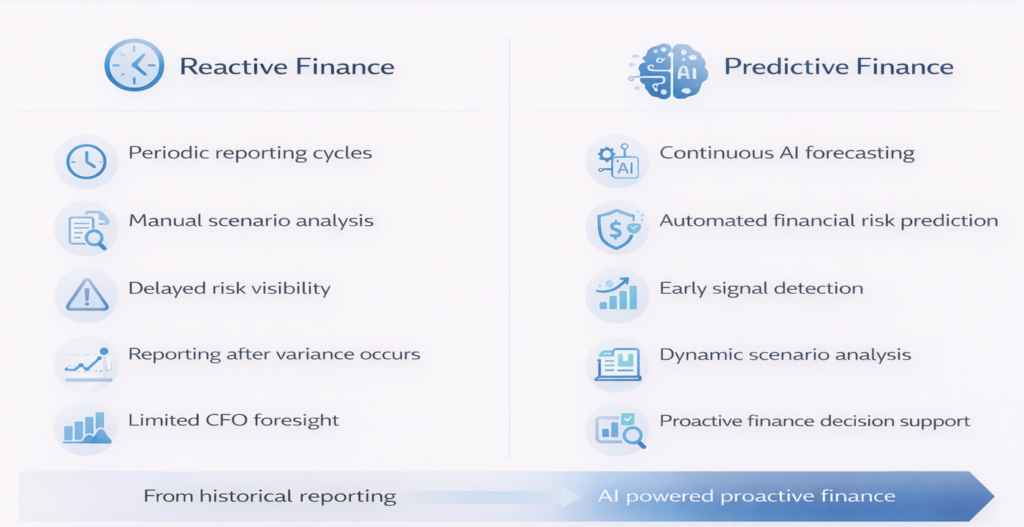
At its core, proactive finance shifts the function from periodic evaluation to continuous signal monitoring. Instead of waiting for deviations to appear in financial statements, predictive models analyze transactional data, behavioral patterns, and external indicators in real time.
How Does AI Forecasting Improve Financial Risk Prediction?
AI forecasting enhances financial risk prediction by identifying subtle correlations that traditional models often overlook. Machine learning systems evaluate historical trends, detect anomalies, and continuously recalibrate assumptions as new data flows in.
This capability strengthens trend detection and refines scenario analysis. When models simulate revenue fluctuations, supplier instability, or cash flow pressure under multiple variables, leadership gains clarity before exposure escalates. Early warnings replace post-event explanations.
PwC’s AI Predictions report emphasizes that organizations embedding AI into forecasting and planning systems gain a measurable strategic advantage because decision intelligence becomes integrated into core operations rather than siloed experimentation. (source)
Where Predictive Finance Creates Tangible Impact
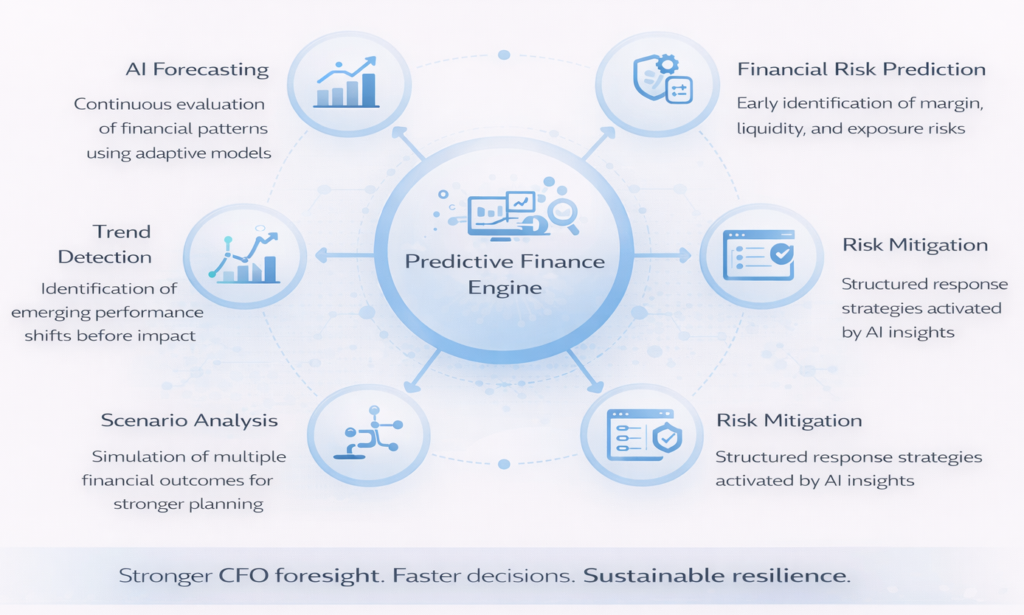
The following shifts define how predictive systems reshape financial planning and execution:
- Continuous Signal Detection- Advanced models scan transactional and operational data to surface irregularities early. This improves financial risk prediction accuracy and reduces dependence on retrospective reconciliation cycles.
- Dynamic Scenario Analysis- Modern scenario analysis evaluates multiple economic and operational variables simultaneously. Finance leaders gain clearer CFO foresight because projections adapt as assumptions evolve.
- Embedded AI Insights- Actionable AI insights are delivered directly into dashboards and workflows. Decision makers respond to forward-looking indicators instead of reacting to lagging reports.
- Structured Risk Mitigation- When warning signals surface early, risk mitigation strategies can be activated before exposure compounds. Proactive finance reduces volatility through anticipation rather than correction.
The Decision Advantage of Early Warnings
A forward-looking model does more than enhance reporting. It changes the tempo of decision-making. With AI forecasting integrated into financial planning systems, budget adjustments and capital allocation decisions can be evaluated against predictive simulations rather than historical averages.
Leadership teams benefit from a measurable decision advantage because the finance function operates as an intelligence engine. When predictive dashboards highlight emerging cash flow strain or margin compression, executives gain time to negotiate contracts, adjust pricing, or rebalance investments.
This structural advantage compounds over time. Faster detection reduces uncertainty. Improved foresight strengthens board confidence. Planning cycles become iterative rather than episodic.
Building Business Resilience Through Predictive Finance
Resilience is often discussed in abstract terms, yet it is fundamentally about preparedness. Organizations that embed predictive finance capabilities into their financial planning infrastructure build operational flexibility.
Predictive systems support business resilience in several ways:
First, they reduce surprise. Early detection limits the scale of negative impact.
Second, they improve capital discipline by aligning investments with projected performance.
Third, they strengthen governance through data-backed forecasting rather than intuition.
When predictive models operate continuously, financial efficiency improves because teams focus on analysis and strategy rather than manual correction.
An AI-powered finance automation platform like Fintropi supports this evolution by embedding AI forecasting, automated data consolidation, and insight-driven oversight directly into core finance workflows. By aligning predictive analytics with financial planning processes, organizations move toward sustained clarity and structured risk mitigation.
From Forecasting to Foresight
Traditional forecasting estimates outcomes based on periodic inputs. Predictive systems evolve those estimates continuously. The distinction may appear subtle, yet its impact is profound.
With structured financial planning supported by adaptive models, CFO foresight becomes proactive rather than reactive. Risk conversations begin earlier. Capital strategies reflect dynamic conditions. Performance management aligns with forward-looking metrics instead of trailing summaries.
This shift repositions finance from scorekeeper to strategic navigator.
Final Thoughts
Reactive finance explains variance after it occurs, while predictive finance reshapes how organizations prepare for it. When AI forecasting strengthens financial risk prediction and embeds actionable AI insights into planning cycles, decision quality improves, and uncertainty becomes manageable.
The thoughtful way forward is deliberate integration. Embed predictive analytics into core financial planning systems. Strengthen scenario analysis with adaptive models. Align risk mitigation frameworks with real-time signals rather than quarterly surprises.
Unlock Predictive Finance and explore how an AI-powered finance automation platform like Fintropi can help your organization transition toward proactive finance, sharper CFO foresight, and durable business resilience.
FAQs
- What is predictive finance?
Predictive finance uses AI forecasting and advanced analytics to anticipate financial outcomes and risks before they materialize. It enhances financial planning by integrating continuous data analysis and forward-looking insights.
- How does AI forecasting differ from traditional forecasting?
Traditional forecasting relies on static assumptions updated periodically. AI forecasting adapts continuously, strengthening trend detection and improving financial risk prediction accuracy.
- Can predictive finance improve CFO foresight?
Yes. By embedding AI insights into dashboards and reporting systems, CFO foresight becomes grounded in forward-looking indicators rather than historical summaries.
- Is predictive finance suitable for mid-sized companies?
Organizations of varying sizes benefit from proactive finance models, particularly when transaction complexity increases, and scenario analysis becomes harder to manage manually.
- How does Fintropi support predictive finance?
Fintropi integrates AI forecasting, automated financial data processing, and insight-driven oversight into unified workflows, helping organizations strengthen risk mitigation and improve finance efficiency.