
Month-end pressure has become so normalized inside finance teams that many leaders no longer question the structure behind it. Yet the recurring strain tied to the traditional finance close process signals a deeper operational issue. When reporting cycles consistently generate urgency, fatigue, and reactive decision-making, the constraint is often cadence rather than capability. Continuous close finance challenges the assumption that financial validation must be concentrated at the end of the month and instead promotes a system where accuracy and oversight operate every day.
Why the Traditional Close Still Creates Friction
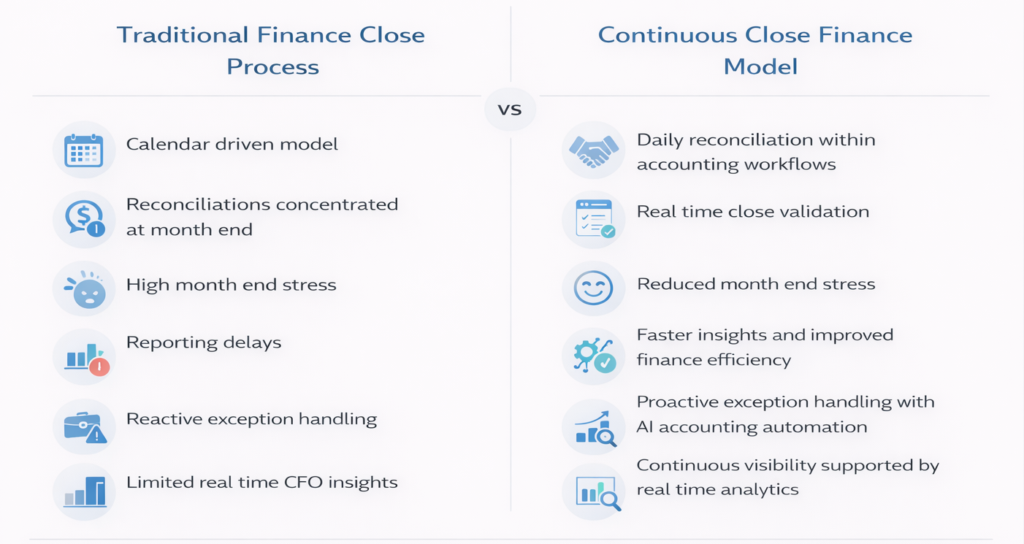
Most organizations still follow a calendar-driven model that compresses reconciliations, reviews, and approvals into a narrow reporting window. As transaction volumes grow, accounting workflows become congested and month-end stress becomes predictable rather than exceptional.
When reconciliations are deferred, discrepancies accumulate quietly in the background. As those unresolved items grow, reporting delays follow, and the pressure to achieve a fast close intensifies. Finance teams end up prioritizing correction over insight, which limits the quality of CFO insights delivered to leadership.
The challenge is structural. Concentrating effort into a short window reduces overall financial efficiency and increases dependency on late-stage adjustments inside the finance close process.
What is continuous close finance, and Why Is It Gaining Attention
Continuous close finance restructures the closing model by embedding reconciliation, validation, and review into daily accounting workflows instead of concentrating them at period end.
In a real-time close environment, transactions are reconciled as they occur. Exceptions are flagged instantly. Journal entries are validated throughout the month. By the time the reporting date arrives, most closed activities are already complete.
This model shifts accounting from periodic correction to ongoing discipline. Instead of clearing backlogs, teams maintain alignment throughout the reporting cycle. A fast close becomes the natural outcome of consistent process design rather than an intense sprint driven by deadlines.
How does AI accounting automation enable a real-time close?
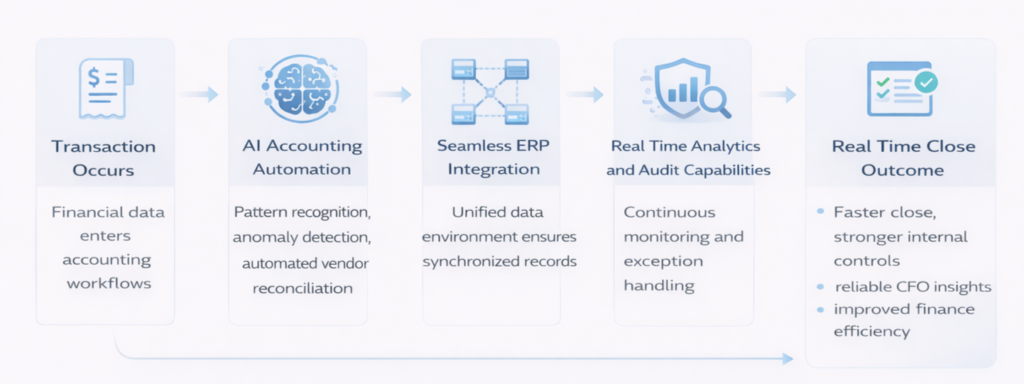
The operational backbone of a continuous model is AI accounting automation. Traditional rule-based systems execute predefined instructions, but intelligent systems analyze patterns, detect anomalies, and improve exception handling dynamically.
Machine learning models evaluate transaction history and flag irregularities early. Automated matching engines support automated vendor reconciliation, reducing manual review cycles. Intelligent routing ensures discrepancies reach the right owner immediately, preventing unresolved balances from accumulating.
An AI-powered finance automation platform like Fintropi embeds these capabilities directly into accounting workflows. When supported by seamless ERP integration for unified data, automation operates on synchronized financial records rather than fragmented datasets, strengthening reliability within a real-time close structure.
Where Continuous Close Creates Measurable Impact
The following are the core operational shifts organizations experience when adopting a continuous close model across their finance function:
- Distributed Workload Across the Month- Continuous validation reduces month-end stress by spreading reconciliations and reviews evenly. Accounting workflows remain stable, which lowers fatigue and improves review quality.
- Improved Accuracy Through Early Detection- Daily anomaly detection supported by AI-driven invoice and payment processing, prevents discrepancies from compounding. Accuracy becomes embedded in routine execution rather than being dependent on last-minute reviews.
- Faster and Clearer CFO Insights- Updated reporting supported by real-time analytics and audit capabilities allows leadership to evaluate performance continuously. CFO insights are based on current data instead of delayed summaries.
- Stronger Finance Efficiency- Intelligent financial workflow automation reduces repetitive manual checks and improves exception handling. Overall finance efficiency increases as teams focus on analysis instead of corrections.
Accuracy Gains and Operational Stability
A real-time close strengthens governance because controls operate continuously rather than periodically. Exception handling improves, and risk exposure declines as discrepancies are resolved early.
An integrated finance automation framework reinforces this structure by combining automation, validation, and monitoring into one coordinated system. Insight-driven financial oversight ensures leaders maintain visibility across accounting workflows without waiting for the formal completion of the finance close process.
When validation becomes continuous, stability follows. Reporting delays shrink, confidence improves, and the objective of a fast close becomes realistic rather than aspirational.
The Strategic Shift Toward Faster Insights
A sustainable fast close matters because it accelerates informed decisions. When financial data remains validated throughout the month, leadership operates with clarity rather than lag.
Continuous close finance transforms the finance close process into a dynamic, controlled system that supports timely analysis. With structured accounting workflows, embedded AI accounting automation, and synchronized systems, finance teams maintain readiness instead of reacting to pressure cycles.
This shift repositions finance as a continuous performance partner, delivering reliable CFO insights while strengthening overall finance efficiency.
Final Thoughts
The recurring monthly crunch is not inevitable. It reflects a closing structure that concentrates validation into a narrow reporting window and creates avoidable strain. Continuous close finance addresses this challenge by embedding reconciliation, oversight, and intelligence into everyday accounting workflows.
When powered by AI accounting automation, supported through seamless ERP integration for unified data, and enhanced with real-time analytics and audit capabilities, organizations move toward sustained accuracy, stronger internal controls, and greater operational resilience.
The way forward is to redesign cadence, distribute accountability across the month, and align technology with decision clarity.
Learn Continuous Close and explore how an AI-powered finance automation platform like Fintropi can help build a resilient real-time close framework that improves control, insight, and long-term finance efficiency.
FAQs
- What makes continuous close finance different from traditional closing methods?
Traditional models compress reconciliations at period end, while continuous close finance distributes validation across the reporting cycle to support a stable real-time close. - How does AI accounting automation reduce month-end stress?
AI accounting automation improves exception handling, automates reconciliations, and strengthens anomaly detection, reducing workload spikes during month-end. - Can continuous close improve CFO insights?
Yes. With continuously validated data, CFO insights are generated using current financial information rather than delayed reports. - Why is ERP integration critical in a real-time close model?
Seamless ERP integration for unified data, like Fintropi, ensures reconciliations and analytics operate on synchronized information, strengthening reporting reliability. - Is continuous close suitable for scaling organizations?
Growing companies benefit from intelligent financial workflow automation like Fintropi because scalable systems maintain financial efficiency as transaction complexity increases.