
Finance automation is often positioned as a cure for inefficiency, error, and delay. Yet many transformation initiatives quietly stall, delivering marginal gains instead of meaningful impact. The issue rarely lies in the ambition to automate. It lies in how automation is designed. Without context, automation scales rigidity rather than intelligence. Understanding the deeper finance automation pitfalls requires examining how systems interpret decisions, handle complexity, and adapt to real business conditions.
The Limits of Rule-Based Automation
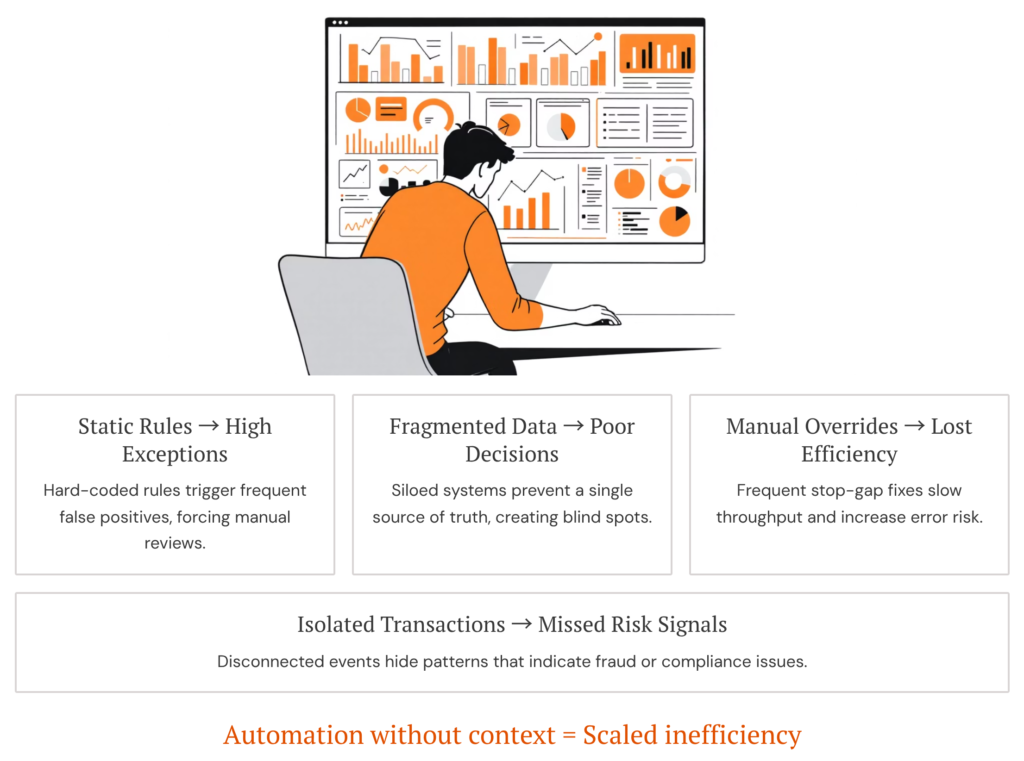
The first wave of finance automation focused on replacing repetitive tasks with predefined logic. Rule-based automation introduced structured approvals, invoice matching, and standardized routing. This approach improved processing speed and reduced manual touchpoints in accounts payable, reconciliations, and reporting.
However, rule engines operate within fixed parameters. They execute predefined instructions but lack interpretive judgment. When inputs deviate from expected formats, systems escalate exceptions rather than resolve them. Over time, exception queues grow, and human intervention increases.
Industry analysis on automation in finance highlights that rigid systems struggle when confronted with evolving transaction patterns, vendor variability, or changing compliance requirements (source). These finance AI limitations emerge when automation is deployed as static logic rather than adaptive intelligence.
In environments defined by financial complexity, static rules inevitably encounter edge cases. What begins as efficiency can quietly evolve into bottlenecks.
Why Context Matters in Finance Systems
Finance decisions are rarely binary. Invoice approvals depend on supplier history, contractual nuances, budget thresholds, and timing considerations. Revenue recognition requires interpretation of terms and conditions. Risk assessments involve behavioral patterns, not isolated data points.
This is where many automation myths begin to unravel. Automation does not inherently create intelligence. It replicates instructions. Without contextual understanding, systems cannot distinguish between legitimate variance and genuine risk.
Effective finance transformation requires systems capable of learning patterns and interpreting data relationships, rather than executing fixed scripts. Context enables systems to assess transaction history, supplier behavior, and operational signals simultaneously.
Without contextual awareness, process failures multiply under scale. Exceptions increase because systems cannot interpret nuance. Finance teams return to manual overrides, eroding trust in automation outcomes.
Can AI Truly Understand Finance Complexity?
The promise of artificial intelligence in finance rests on its ability to move beyond rigid scripting. Yet not all AI implementations deliver contextual reasoning.
AI can interpret financial complexity only when designed as a context-aware AI system rather than a narrow automation layer.
Modern AI models analyze structured and unstructured data, recognize behavioral patterns, and refine decisions over time. Research from McKinsey highlights that organizations integrating advanced analytics into financial operations report stronger decision support and improved operational reliability (source).
However, implementation quality determines outcome. If AI is trained on incomplete data, disconnected systems, or inconsistent workflows, it inherits those weaknesses. Finance AI limitations often reflect fragmented architecture rather than algorithm capability.
True contextual intelligence requires integrated data ecosystems, historical visibility, and structured governance. When these foundations exist, AI evolves from a task executor to an analytical partner.
Intelligent Workflows as the Missing Layer
The bridge between rigid automation and adaptive intelligence lies in intelligent workflows.
Intelligent workflows combine automation logic with contextual interpretation. Instead of escalating every deviation, systems analyze historical precedent, supplier performance trends, and approval hierarchies before triggering intervention.
For example, in accounts payable, an invoice outside standard tolerance may still align with historical contract adjustments. A context-aware system recognizes the pattern, validates the deviation, and processes it without unnecessary delay.
This approach reduces manual exception handling and strengthens reliability. Instead of adding layers of oversight, intelligent workflows embed oversight within the process itself.
Open industry research examining AI integration into finance operations underscores that embedding intelligence directly into workflows enhances resilience and reduces repetitive escalation cycles (source).
By shifting from static routing to contextual evaluation, organizations address the root causes of recurring process failures.
How Better Context Enables Better Decisions
Finance automation fails when it optimizes tasks but neglects decision quality.
Decision quality improves when systems interpret transaction patterns, assess risk signals, and update outputs dynamically. Context-aware AI supports adaptive exception handling, predictive forecasting adjustments, and continuous anomaly detection.
In contrast, traditional rule-based automation treats each transaction in isolation. It lacks memory of prior behavior and cannot anticipate emerging patterns.
Adaptive systems leverage cumulative data to refine outputs over time. This capability transforms automation from a cost-saving mechanism into a strategic asset. Adaptive systems interpret not only what is happening but why it may be happening.
As financial environments grow more interconnected, financial complexity increases. Multiple revenue streams, subscription models, cross-border transactions, and regulatory variations introduce layers of nuance. Context becomes the difference between reliable automation and systemic friction.
Common Finance Automation Pitfalls
Organizations repeatedly encounter predictable finance automation pitfalls when context is ignored.
The following are the most common challenges that undermine automation success:
- Overreliance on static rules- Excessive dependence on rule-based automation creates brittle systems that cannot adapt to operational change.
- Fragmented data architecture- Disconnected systems prevent AI from accessing a comprehensive transaction history, limiting contextual interpretation.
- Escalating exception handling- High volumes of manual review erode confidence in automation and negate efficiency gains.
- Misaligned governance frameworks- Automation initiatives deployed without structured oversight amplify risk exposure rather than mitigate it.
- Underestimating financial complexity- Treating finance workflows as uniform tasks ignores contractual nuance, vendor variability, and regulatory dynamics.
Addressing these issues requires more than incremental software upgrades.
Smarter Automation Requires Structural Alignment
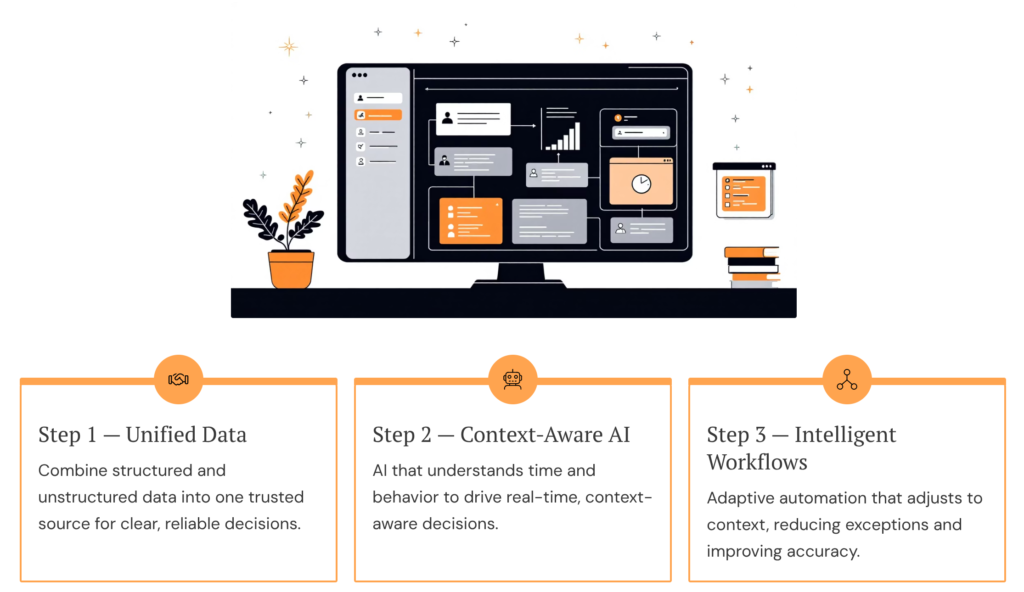
Smarter automation emerges when contextual intelligence is embedded within integrated systems.
Organizations progressing toward intelligent finance invest in unified data layers, continuous monitoring capabilities, and governance clarity. Rather than layering automation onto outdated architecture, they redesign workflows around contextual evaluation.
An AI-native Autonomous Finance Operations Platform like Fintropi illustrates how context-aware AI can operate within structured compliance frameworks. By combining intelligent workflows, adaptive exception handling, and unified ERP connectivity, automation becomes responsive rather than rigid.
This structural approach mitigates finance AI limitations by ensuring intelligence is supported by accurate, accessible data.
The Strategic Shift Toward Context-Aware Systems
The evolution of automation reflects a broader transformation in finance leadership priorities. Efficiency remains important, yet resilience and insight have become equally critical.
Context-aware AI enables finance leaders to shift focus from reactive validation toward proactive analysis. Instead of spending time resolving process failures, teams interpret trends, optimize capital allocation, and anticipate risk exposure.
Better decisions stem from systems that understand relationships between transactions, vendor behavior, and operational drivers. Intelligent workflows reduce friction without sacrificing control.
Automation myths often assume that scale alone guarantees progress. In reality, scale magnifies design flaws. Context ensures scale amplifies intelligence rather than inefficiency.
Wrapping Up
Automation without context replicates limitations at speed. Addressing finance automation pitfalls requires moving beyond rigid rule engines toward context-aware AI supported by intelligent workflows and adaptive systems.
Organizations that acknowledge the complexity of finance and embed contextual reasoning into their automation architecture achieve higher decision quality, reduced exception handling, and greater operational resilience. Smarter automation strengthens governance instead of weakening it.
Explore Intelligent Finance and discover how context-aware AI and intelligent workflows can transform finance automation into a strategic advantage that supports better decisions and sustainable performance, enabled by an ERP-integrated finance automation platform like Fintropi, built to unify data, strengthen oversight, and deliver adaptive, insight-driven financial operations.
FAQs
- What are the most common finance automation pitfalls?
Common pitfalls include overreliance on rule-based automation, fragmented systems, high exception volumes, and underestimating the complexity of finance.
- What is context-aware AI in finance?
Context-aware AI interprets transaction history, behavioral patterns, and operational signals to make informed decisions rather than executing static rules.
- How do intelligent workflows differ from basic automation?
Intelligent workflows integrate adaptive systems and contextual evaluation, reducing manual exception handling and improving reliability.
- Why do automation myths persist in finance?
Automation myths persist because efficiency gains are visible early, while deeper process failures surface gradually as complexity increases.
- How can organizations build smarter automation?
Organizations can build smarter automation by integrating a unified data architecture, embedding context-aware AI, and leveraging an intelligent financial workflow automation platform like Fintropi to align automation with governance frameworks and insight-driven decision-making.